

Editor's note: This article was produced by a student participating in the course J477/577: Strategic Science Communication, a collaboration between the School of Journalism and Communication’s Science Communication Minor program and the Research Communications unit in the Office of the Vice President for Research and Innovation.
As climate change and urban expansion in the Pacific Northwest put pressure on agricultural land and food distribution, increasing building-integrated agriculture in urban areas could be a pathway to a more resilient food system and a sustainable future.
Gwynne Mhuireach, a research assistant professor at the Institute for Health in the Built Environment (IHBE), is conducting a US Department of Agriculture (USDA)-funded study showing how building-integrated agriculture benefits urban areas. She hopes this research will facilitate greater food production.
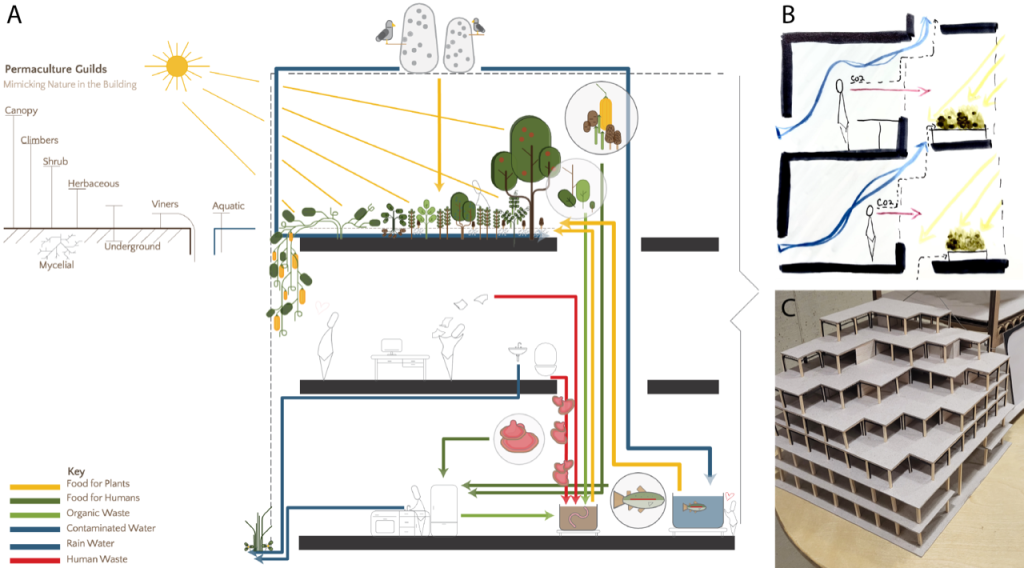
Building-integrated agriculture includes rooftop farming, green facades, and controlled-environment agriculture, such as aquaponics.
"There’s all this building space that’s really unused—we can put food production in all those spaces,” Mhuireach said.
Mhuireach is especially interested in novel agricultural technologies such as aquaponics and aeroponics (growing methods that don’t require soil), which she hopes will help diversify forms of agriculture in urban areas.
Using urban agriculture to strengthen cities and food systems
Integrating agriculture into our buildings can improve the buildings themselves. Mhuireach notes that urban agriculture can increase the energy efficiency of buildings, for example, by putting greenhouses on the tops of buildings to help buffer the incoming solar heat gain. This allows buildings to stay cooler while mitigating stormwater runoff.
"Buildings use a ton of energy and are a big part of the climate problem,” said Mhuireach. "If we could tackle that question by using food production to lower the energy use of buildings then that would be a benefit.”
Mhuireach emphasized how adding food production locations in the city can buffer the impacts of food shortages from climate change, pandemics, and more.
"We want to make urban areas more resilient to food supply crises and also bring food closer to the people who need it,” she said.
Collaborating with other universities to build a stronger future
This project is funded through a four-year grant from the USDA National Institute of Food and Agriculture, and it is a collaboration between IHBE, the Oregon State University (OSU) Horticulture Department, and Washington State University Extension.
The UO’s role in this collaboration includes a literature review of architectural precedents, a survey of architects, engineers, and other relevant people in the building industry, and an undergraduate design studio, among other objectives.
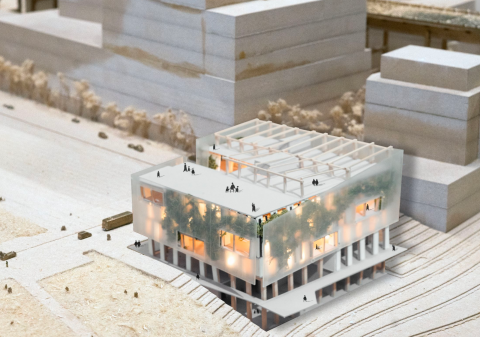
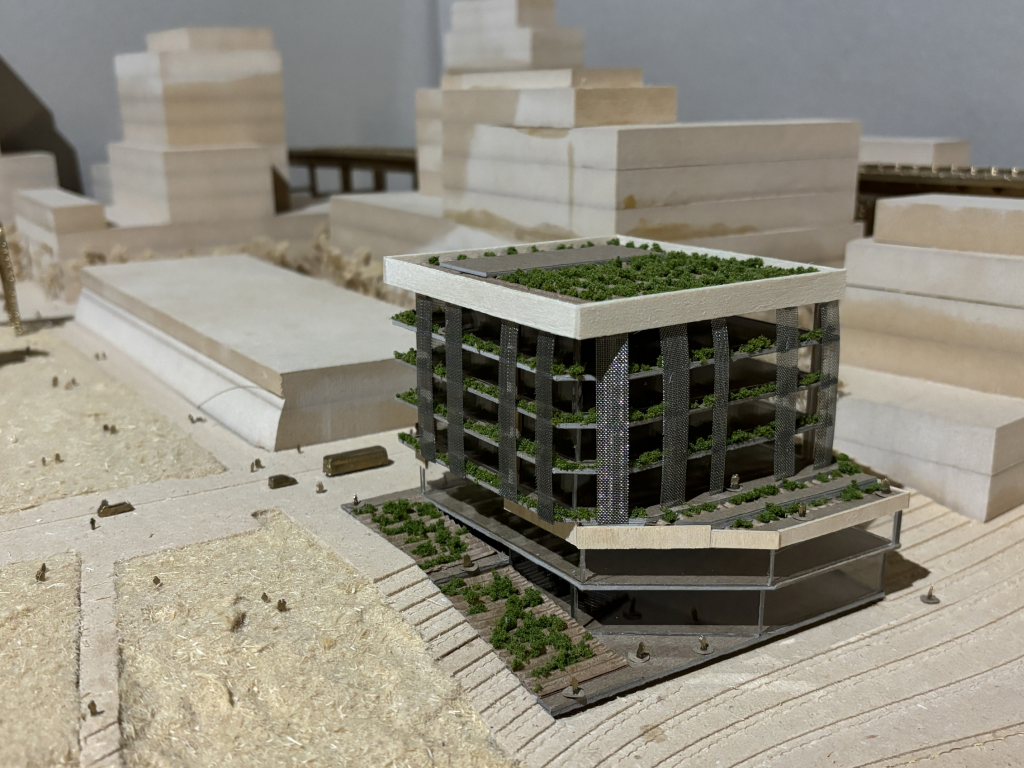
The students in the design studio are redesigning an old industrial site in the Portland area. This redesign will show how building-integrated agriculture might look when implemented.
Walking around the design studio where the students’ plans for urban agriculture are on full display is a hope-building experience: There are people actively working to make buildings fight climate change and provide sustenance.
These architecture students collaborate with students from OSU in a class on horticulture in the built environment. The UO students design the buildings, while the OSU students ensure the agricultural aspects of the buildings are functional and efficient. This cross-university collaboration benefits the entire region.
Current setbacks to implementing urban agriculture
While building-integrated agriculture is a wonderful path forward, there is a long way to go. Mhuireach said that while there is interest in incorporating agriculture into buildings, barriers such as cost often keep this from happening.
She says architects often include building-integrated agriculture in their original plans, but it often gets cut out of the final plans to save money.
"We’re hoping to address that problem,” she said. “We need a way to not let it be value-engineered out because it’s important to produce food in the city.”
In addition to cost, there are other difficulties with increasing urban agriculture, such as finding the labor required to manage the gardens.“
You don’t have farmers who are waiting for a building to be built to go farm it,” she said.
Instead, Mhuireach hopes this work can keep people more connected to their food.
"It’s also really important to connect people with their food,” she said. “I actually think it’s kind of a bad thing that all of our food is grown somewhere else, and we don’t even know how it gets to our table.”